
KS3 Photography Competition - 2026 dates to be announced
What is Fluid Dynamics?
Have you ever wondered why water spins down a plug hole? Why bubbles are round? Or why on the weather report they talk about high and low pressure? All these questions can be answered if you know a little something about fluid dynamics!
But what is fluid dynamics? A fluid is something that flows, such as gases and liquids, and the dynamics are their movements when they flow. Fluid flows are all around us and understanding how and why they flow the way they do is important to our everyday lives.
The following blog posts, written by some of our CDT students, will teach you about important properties of fluids, finding out how each influences the way a fluid moves and how we see their impact in the real-world.
Competition: Capturing Fluid Dynamics 2026
The CDT in Fluid Dynamics' photography competition for schools, inviting KS2 and KS3 students to capture and visualise everyday fluid dynamic phenomena. We would greatly appreciate your help in sharing this opportunity with your networks of science teachers across the UK.
- This year’s theme: to be announced!
- Prizes: Winning students will receive Amazon vouchers worth up to £40.
- Deadline for entries: to be announced!
Let’s inspire young minds to explore the beauty and science of fluid dynamics!
2023 Winners
Read about our 2023 Winners - students were asked to submit a photograph, a series of photographs, or a video related to the theme of “fluids in nature".
Examples of the Beautiful World of Fluid Dynamics
Scientific photography can be incredibly helpful in improving our understanding of the world.
Surface Tension and Wettability: A Case Study on Scientific Images
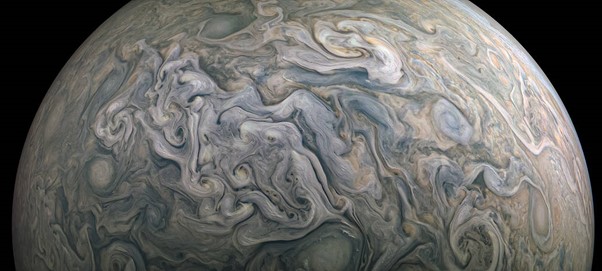 Figure 1: See more photos of Jupiter.
The giant gas planet has storms which result in beautiful patterns on the surface. In 2016, the Juno space mission arrived at Jupiter and took many photos of the lesser seen north and south poles, shown in the photo below. These photos were very important to scientists and helped increase their understanding of the physical processes going on at the surface and in the interior of Jupiter.
Scientific imaging is important as it can demonstrate scientific concepts. Not only can we catalogue and record actual measurements in these images, but we also convey a story and showcase scientific phenomena more engagingly, making it accessible for everyone. By opening up the conversation to more people, we can have a diverse discussion about stuff that matters and help raise awareness about important issues.
Droplets: Water on the Wing of a Cicada Insect
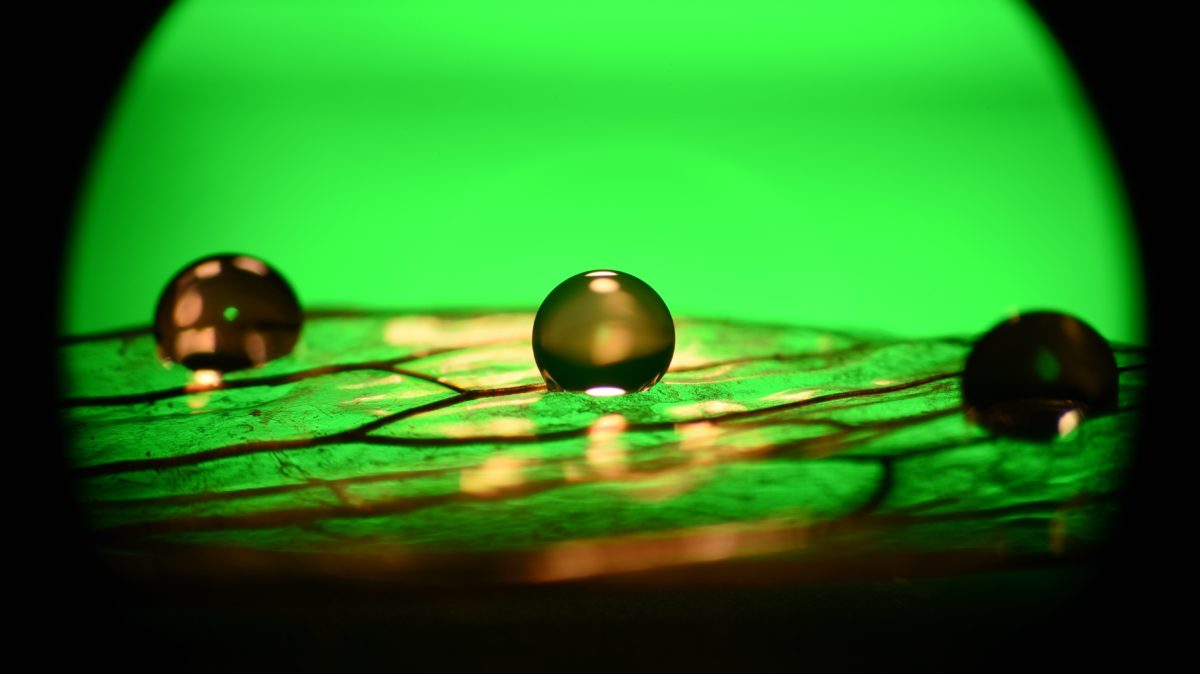
This scientific image depicts water droplets on the wing of an insect. As water is a polar molecule, meaning one end is slightly positively charged, while the other slightly negative, the molecules have a strong attraction. This is known as a cohesive force, which is why water has a high surface tension and forms spherical droplets even on some solid surfaces. This picture showcases the waterproof nature of the wing surface due to the cohesive force in the water molecules being much stronger than the adhesive force to the surface due to the unique properties of the wing’s structure. This property is what gives the wings self-cleaning and waterproof qualities.
This image was taken using an SLR camera with a macro lens. A special green back light was used in this laboratory set-up as it gives a high contrast between the subject and the background, making it easier to get quantitative data in our experiments. It is important to frame the picture well with the subject clear and focused, showcasing the details you want to see. In this case, the main subject is the central water droplet which is in sharp focus in the centre of the image. Part of the wing structure can also be seen as this makes it more clear what the photo is of.
Morning Dew: In My Garden
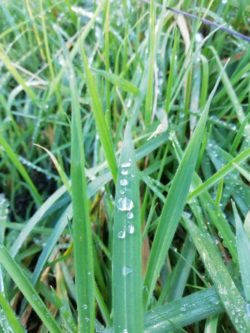
Although the top image was taken in a laboratory environment, images can be reconstructed from simple observations in everyday life. Below is a picture that demonstrates the same underlying
concepts, where the morning dew has formed spherical droplets on the blades of grass in my garden.