
Student Spotlight: Chris Jackson
Annual European Conference of Rheology (AERC 2026)
Talk: Modelling 3D printing of rheologically complex materials using OpenFOAM
I presented my work at the Annual European Rheology Conference (AERC 2026), which brings together researchers from across Europe, with 24 different countries attending. The conference is highly relevant to my field, as my research focuses on modelling viscoelastic flow behaviour in extrusion-based 3D printing, where understanding polymer rheology is essential for predicting stresses that occur in 3D printing and how this affects the print quality.
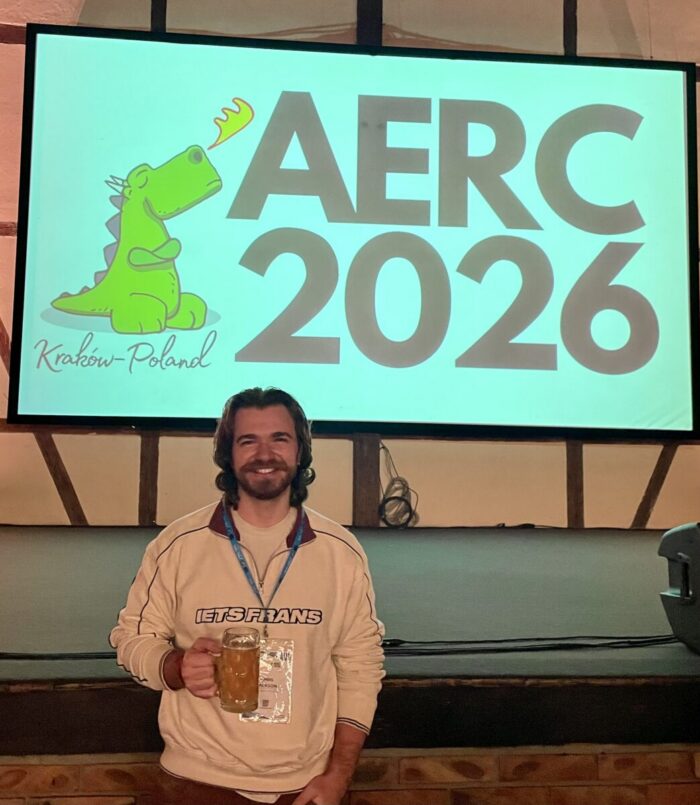 Image: Chris Jackson at AERC 2026
My project investigates the fluid dynamics of polymer extrusion and deposition using computational fluid dynamics, using the open source software OpenFOAM with the rheoTool toolbox. In particular, I model the process as a multiphase flow and incorporate viscoelastic effects through the Rolie–Double–Poly (RDP) constitutive model. The work compares Newtonian and viscoelastic behaviour, as well as 2D and 3D simulations, to understand how these affect the printed strand.
The key message of my presentation was that 2D and 3D simulations exhibit fundamentally different flow behaviour. In particular, 2D tends to introduce unphysical backflow and over-predict die swell due to geometric confinement, whereas 3D allows for biaxial spreading, giving a more realistic representation of the deposition process. We found that viscoelasticity does influence the height and the physics that are involved, but the lateral spreading in 3D remained the same. This suggests that in 3D, the geometric differences between Newtonian and viscoelastic cases are much less pronounced than observed in 2D. We also observe that stresses are highest near the walls and surface, which is where the quickest cooling would occur, which could lead to frozen-in residual stresses in the final strand.
The audience was engaged, with questions focusing on two areas: how I characterised the polymer filament and a discussion around how these simulations could be validated experimentally. These questions helped highlight the need to perform practical experiments to give confidence that my work correctly models the real world.
The conference provided valuable networking opportunities, including discussions with other PhD students and researchers working on related CFD and rheology problems, where we shared computational challenges and tips and tricks to get the simulations computationally stable.
Overall, this experience significantly benefited my development. It improved my ability to communicate complex ideas to a specialist audience, increased my confidence in presenting, and raised the visibility of my work within the community.
In the future, I plan on further development of my computational model to add thermal modelling to the simulation and explore experimental validation. I also aim to be able to model more complex geometries to match those used in industry. I intend to present new work at future conferences, particularly UK fluids and the 20th International Rheology Conference.