
Researcher Spotlight: Luke Driver
Optimising Supersonic Nozzles
to Investigate Interstellar Chemical Kinetics With CFD
Dr Greg de Boer (supervisor)
Luke Driver (pgr)
PhD Project: Computational fluid dynamics analysis and optimisation of Laval nozzles for low temperature kinetics
This project brings together core expertise in CFD and chemical kinetics to optimise the design of Laval nozzles used to measure the reaction rates taking place in very low temperature environments (< 100 K) which represent the conditions of interstellar media and their formation. The purpose of these optimised nozzles is to reduce the oscillations in temperature resulting from the supersonic wake when gas is pulsed through the apparatus, chemists can then use spectroscopy techniques to initiate reactions at specific conditions and use this data to inform kinetic models. Previous nozzle designs for these purposes have been heavily empirical with numerous iterations of expensive to manufacture nozzles and time-consuming experiments required to carry out any useful data collection. This project represents a significant paradigm shift in the approach and understanding of these flows as well as the best nozzle designs to use for specific conditions, with the combined CFD and optimisation approach allowing previously unknown nozzle shapes to be realised and tested for consistency. The toolkit is publicly available and now being used by multiple group in the UK and Europe to accelerate nozzle designs for a range of conditions and different experimental setups, these improvements have subsequently enabled chemical kinetics researchers to better understand the composition of interstellar media and the formation of stars and planets which has benefit to society in understanding the origins of life and the Universe itself.
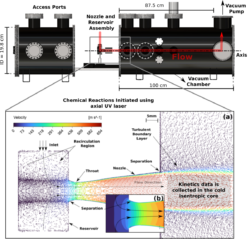
The project successfully integrated CFD and data-driven approaches into the chemical kinetics sensing field, which has historically relied on experimental and analytical methods for flow characterisation and nozzle design.
- Developed and validated an automated CFD tool that is now used across the kinetics community (Durham, Birmingham, and Leeds). Following publication of our methodology, multiple chemistry groups have adopted CFD for nozzle design and flow characterisation for the first time, increasing confidence in the approach and enabling wider application. The full tool has been openly released on GitHub.
- Introduced surrogate-based metamodeling to the nozzle design process, allowing Leeds and Birmingham to design nozzles that meet highly specific performance targets. The new process is significantly more robust than existing methods and eliminates the need to manufacture and test multiple prototypes. As a result, these groups can now access a wider temperature range for kinetics studies compared to legacy nozzle designs.
- Applied the CFD tool to support chemistry calculations in a recent publication, with substantial potential for inclusion in upcoming studies. Its use improves the reliability of flow characterisation, thereby increasing the accuracy of experimental interpretation and strengthening the scientific output of the community.
"Throughout this project, I developed a much deeper understanding of supersonic CFD modelling, software development, and optimisation strategies by applying them to design temperature tuneable nozzles for chemical kinetics. Working within a multidisciplinary team was particularly rewarding, as it pushed me to communicate ideas clearly across different areas, while the experimental side of the project gave me valuable perspective beyond purely numerical work. Overall, this experience greatly strengthened my confidence in CFD and has been a genuinely rewarding opportunity for both my technical and professional growth."
Luke Driver, CDT 2021 Cohort PhD Student