Student Spotlight: Megan Richards
APS DFD 22nd-25th November 2025
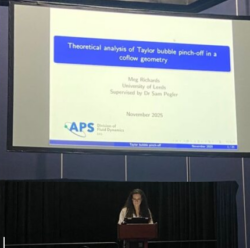
Talk: Theoretical Analysis of Taylor Bubble Pinch-off in a Coflow Geometry
I had the opportunity to attend the 78th Annual Meeting of the APS Division of Fluid Dynamics in Houston, Texas. The conference included experts and students from around the world and focused on the latest developments in fluid dynamics. Over the course of several days, I attended interesting talks on a wide range of diverse topics and was able to network with both early-stage researchers and established leaders in fluid dynamics.
On the final day, I gave a presentation on my recent work on Taylor bubble formation in a coflow geometry. My work focuses on the mathematical analysis of two-dimensional Taylor bubble formation and implements a lubrication theory for the necking region between the bubble injection nozzle and the developing Taylor bubble. A key result is to demonstrate a quasi-static limiting theory of the necking dynamics for small capillary numbers. The theory is based on coupling an outer near-static regime of the pinching film with an apparent dynamic contact line that matches the necking zone to the film surrounding the Taylor bubble. This asymptotic structure, which becomes more refined in the limit of small capillary number, reveals a fundamental link between capillary pinch-off dynamics and the quasi-static regimes underlying spreading droplets. The theory yields a prediction for the dimensionless pinch-off time and provides analytical insight into injection-driven pinch-off dynamics and the parametric control of its frequency.
The audience responded positively, asking detailed questions about the conditions for Taylor bubble formation. Several attendees expressed interest in future collaboration, particularly in the context of combining the theoretical framework with experimental validation. Their questions and feedback also offered new perspectives on extensions of the analysis and its application to more complex geometries.
Networking at the conference was highly valuable. I engaged in discussions with fellow early-career researchers and senior researchers, exchanging ideas on related problems and exploring collaborative opportunities. These interactions not only expanded my professional network but also inspired potential new research directions. Attending the conference strengthened my presentation and communication skills, increased the visibility of my work, and boosted my confidence in engaging with an expert audience.